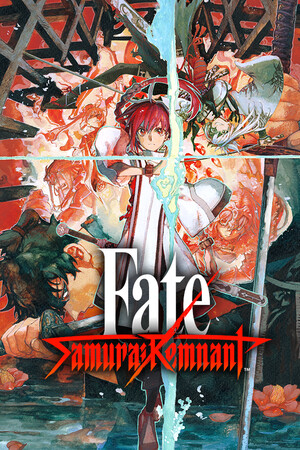
Fate/Samurai Remnant
Throughout the Fate franchise, pairs of masters and heroic spirits —also known as servants— have been fighting across history in a series of Holy Grail Wars, with the winning duo receiving an ancient artifact that grants wishes. Fate/Samurai Remnant continues the series’ epic Holy Grail War in the fourth year of the Keian Era, Edo Period Japan. It has been several decades since the end of a turbulent, blood-soaked era, and while the people are finally enjoying peace and tranquility, a battle between seven pairs of masters and servants is about to begin as the “Waxing Moon Ritual” unfolds in the shadows. This is where the game’s hero, Miyamoto Iori, a young man in Asakusa, finds himself caught in the violence alongside his servant Saber, as they fight to be the last pair remaining in order to receive the granter of wishes, the “Waxing Moon Vessel”.
What it feels like
Sincere, unironic emotional stakes around the Holy Grail War and character arcs. The peaceful Edo setting contrasts with violent Holy Grail conflict; victory means loss for others.
What it's about
A hero and servant pair undertake a classic quest against rivals to obtain the wish-granting Grail. Grounded in Edo Period Japan (Keian Era) with authentic historical setting and atmosphere. Heroic spirits, magic, and supernatural Holy Grail War as the core premise.
How it plays
Deep combo-driven melee combat scored on stylish execution is central to moment-to-moment gameplay. Core gameplay revolves around the master-servant pair as a dual-character team system. Branching conversation choices drive story progression and relationship-building with allies.
How it looks and sounds
Japanese anime-inspired character design and visual presentation throughout. Characters fully voiced, supporting the rich narrative and visual novel elements.
How it's structured
A bounded story arc across the Holy Grail War with a definite narrative conclusion and multiple endings. Multiple endings indicate player choices meaningfully diverge the story path. Single-player focused experience with no multiplayer component.
Kindred games

Shares Character Action, Anime Style, Heroic Quest, Party Management.
Both lean into Character Action, Campaign, Anime Style, Heroic Quest.
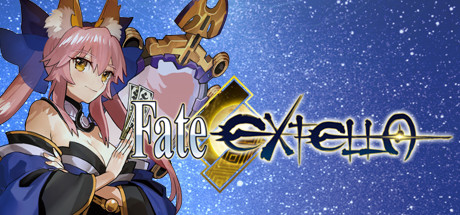
Shares Character Action, Anime Style, Party Management, Supernatural & Occult.
Both lean into Campaign, Character Action, Anime Style, Party Management.
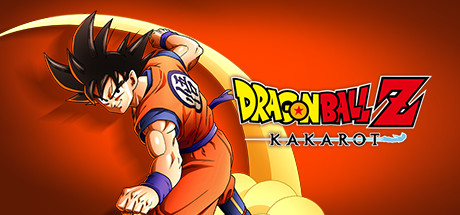
Shares Heroic Quest, Character Action, Anime Style, Party Management.
Both lean into Campaign, Heroic Quest, Character Action, Anime Style.
See all games like Fate/Samurai Remnant →
Closest hidden gems
A lesser-known kindred — Character Action, Anime Style, Party Management, Supernatural & Occult. 91% positive across 4,466 Steam reviews.
Both lean into Campaign, Character Action, Anime Style, Party Management.
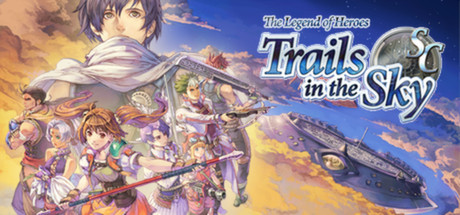
A lesser-known kindred — Party Management, Branching Narrative, Anime Style, Dialogue Trees. 98% positive across 4,325 Steam reviews.
Both lean into Campaign, Party Management, Branching Narrative, Anime Style.
A lesser-known kindred — Branching Narrative, Anime Style, Dialogue Trees, Relationship Sim. 88% positive across 4,818 Steam reviews.
Both lean into Branching Narrative, Dialogue Trees, Anime Style, Relationship Sim.