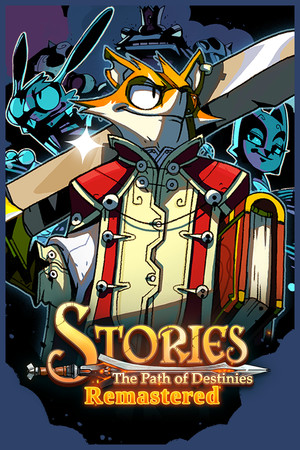
Stories: The Path of Destinies
Reynardo the Fox is a clever rogue, but he’s not as clever as he thinks. He's got himself sucked into a Rebellion against the mad Emperor, and now he’s got fateful choices to make. Should he rescue his oldest friend, the shiftless Lapino; wield a gem cursed by a dead god; or resurrect a weapon lost at the beginning of time? Worse, he’s still in love with the Emperor’s adopted daughter, who he met in sword fu school. He’s got dozens of ways to screw this up; but is can he find a way to win his war? Stories: The Path of Destinies is madcap epic fantasy where each choice you make takes you into a different story. But each story — some dark, some romantic, all action-packed — is true in its way, and will lead you to victory if you pay enough attention...
What it feels like
The game is described as 'madcap,' with quirky charm and absurdist humor throughout its fanciful fantasy world and narrator. Lighthearted irreverence and mischief characterize the tone, inviting players to experiment with different narrative branches and choices. High-energy, colorful fantasy adventure with a joyful, vibrant tone despite darker thematic branches available.
What it's about
An epic secondary world of rebellion against a mad Emperor with magic, curses, ancient weapons, and classic fantasy stakes. Reynardo's romantic entanglement with the Emperor's adopted daughter is a recurring narrative thread affecting choices and outcomes. Reynardo undertakes a rebellion against a mad Emperor, following a classic hero's-journey structure despite the madcap tone.
How it plays
Fast melee combat against enemies is a core loop, described as 'action-packed' and featuring 'swordplay' as a central mechanic. Branching conversation and decision trees are central to how the narrative forks and how player agency shapes the story. Stylish melee combat with zippy narrator feedback rewards expressive, skillful execution in action sequences.
How it looks and sounds
The isometric perspective is explicitly mentioned in Steam user tags as a defining visual presentation. A 'zippy narrator attuned to the player's choices' suggests strong voice performance integral to the storytelling experience.
How it's structured
Designed entirely for single-player experience with no multiplayer component. Player choices fork the story into meaningfully different paths, with dozens of ways to proceed and multiple distinct endings based on decisions. The game explicitly offers multiple endings contingent on player choices and attention to story details across different narrative branches.
Kindred games

Shares Branching Narrative, Multiple Endings, Dialogue Trees, Playful.
Both lean into Single-Player, Campaign, Branching Narrative, Multiple Endings.
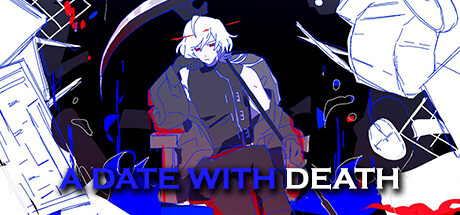
Shares Branching Narrative, Dialogue Trees, Playful, Love & Romance.
Both lean into Branching Narrative, Single-Player, Dialogue Trees, Playful.

Shares Branching Narrative, Multiple Endings, Dialogue Trees, Playful.
Both lean into Single-Player, Branching Narrative, Dialogue Trees, Multiple Endings.
See all games like Stories: The Path of Destinies →
Closest hidden gems

A lesser-known kindred — Branching Narrative, Multiple Endings, Dialogue Trees, Full Voice Acting. 97% positive across 4,670 Steam reviews.
Both lean into Single-Player, Branching Narrative, Multiple Endings, Dialogue Trees.

A lesser-known kindred — Branching Narrative, Multiple Endings, Dialogue Trees, Love & Romance. 88% positive across 4,818 Steam reviews.
Both lean into Single-Player, Branching Narrative, Multiple Endings, Dialogue Trees.
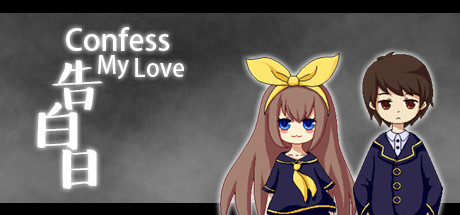
A lesser-known kindred — Branching Narrative, Multiple Endings, Dialogue Trees, Love & Romance. 94% positive across 4,870 Steam reviews.
Both lean into Single-Player, Branching Narrative, Multiple Endings, Dialogue Trees.