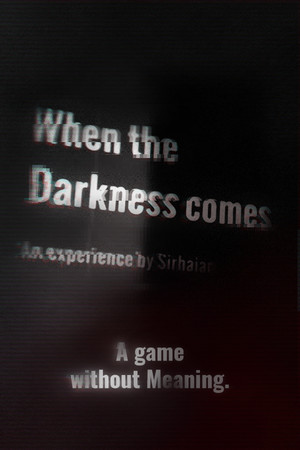
When the Darkness comes
Taking around an hour on the first play-through, "When The Darkness Comes" feels like you're wandering around a glitchy hard drive full of abstract dreams and beautiful nightmares. The narrator initially makes it feel like a comedic game, but it soon starts to take a darker tone as you travel down the bizarre broken rabbit hole that explores the darkest themes of the human mind.
What it feels like
The shift from comedic narration to darker tone creates slow-building anticipatory fear and unease throughout the descent. The exploration of depression and anxiety creates a pervasive wistful sadness finding beauty in psychological decay. A philosophical walking simulator invites reflection and interpretation of the surreal imagery and emotional weight.
What it's about
The game explicitly 'tries to illustrate the hardships of depression and anxiety' through its narrative and environments. Psychological horror rooted in the mind is the dominant theme, exploring trauma and disturbed mental states rather than supernatural threats. The game explicitly uses 'abstract dreams and beautiful nightmares' as its core aesthetic and narrative vehicle.
How it plays
The dynamic narration and the tag 'Choices Matter' suggest dialogue and narrative branching based on player decisions. As a walking simulator, the core interaction likely involves navigating and interacting with hotspots in the environment.
How it looks and sounds
The game is explicitly a first-person walking simulator, with the player viewing abstract landscapes directly through a fixed perspective. The entire experience is framed as 'wandering around a glitchy hard drive full of abstract dreams and beautiful nightmares' with surreal, impossible imagery throughout. The dynamic narration is central, suggesting sparse but carefully placed audio rather than a constant musical score.
How it's structured
Explicitly designed as a single-player experience with no multiplayer component. Around an hour on the first play-through makes this a compact, bite-sized narrative experience. Despite its brevity, the game has a definite arc from comedic tone to darker exploration, forming a bounded authored story.
Kindred games

Shares First-Person, Dread, Psychological Horror, Dreams & Subconscious.
Both lean into Single-Player, First-Person, Dread, Psychological Horror.

Shares First-Person, Surreal Visuals, Dreams & Subconscious, Dread.
Both lean into Single-Player, First-Person, Surreal Visuals, Dreams & Subconscious.
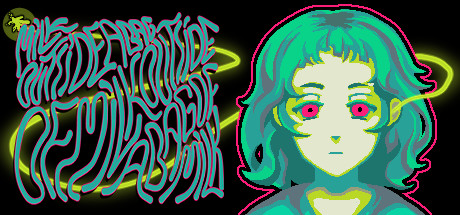
Shares Psychological Horror, Surreal Visuals, Mental Health, Uncanny.
Both lean into Single-Player, Psychological Horror, Surreal Visuals, Mental Health.
See all games like When the Darkness comes →
Closest hidden gems
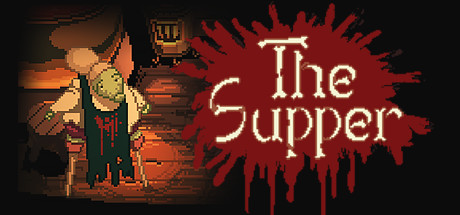
A lesser-known kindred — Psychological Horror, Mental Health, Dread, Short Playtime. 99% positive across 4,402 Steam reviews.
Both lean into Single-Player, Psychological Horror, Mental Health, Dread.

A lesser-known kindred — First-Person, Dread, Psychological Horror, Short Playtime. 90% positive across 4,526 Steam reviews.
Both lean into Single-Player, First-Person, Short Playtime, Dread.

A lesser-known kindred — First-Person, Psychological Horror, Dread, Contemplative. 89% positive across 4,904 Steam reviews.
Both lean into First-Person, Single-Player, Psychological Horror, Dread.