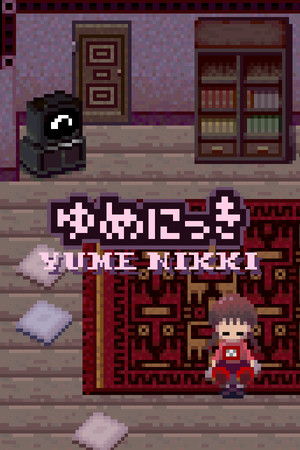
Yume Nikki
Yume Nikki is a 32-Bit freeware game created by Kikiyama, a Japanese solo game designer. The game was made using RPGMaker 2003. The game is regarded as one of the most original applications of RPGMaker 2003, and the start of a possible new genre of games. "Yume Nikki" means "Dream Diary" in Japanese, and the game follows a young girl named Madotsuki as she dreams. The goal is to seek out and acquire all 24 'Effects'. The game otherwise has no plot, and nearly the entire game is left up to speculation.
What it feels like
The almost-familiar rendered subtly, disturbingly wrong defines the emotional register throughout — mundane imagery warped into wrongness. A pervasive solitude and isolation; the small self navigating vast, empty, incomprehensible dream spaces. An enigmatic pull of secrets half-glimpsed and answers withheld structures the entire experience; meaning is deliberately obscured.
What it's about
The game is explicitly structured as the dream diary of the protagonist; dream logic and the subconscious mind define the entire world. The protagonist's motivations, the purpose of effects collection, and the dream's meaning are deliberately left unresolved and enigmatic. Horror derives from surrealism, unsettling imagery, and the uncanny atmosphere rather than jump-scares; the mind and its terrors are central.
How it plays
Interaction with the dream world is largely clicking hotspots to examine, use, and interact with the environment. Seeking out and discovering the 24 effects scattered through the world involves finding and observing scenes for items of significance.
How it looks and sounds
Dreamlike, impossible imagery and illogical spaces are the core aesthetic — defying physical logic is fundamental to what Yume Nikki is. The game is rendered in deliberate 32-bit pixel art, a defining visual signature of the experience. Visuals are often sparse and uncluttered, stripping scenes to essential shapes and unsettling emptiness.
How it's structured
The game is explicitly single-player with no multiplayer component; solitary exploration is fundamental to the experience. The dream world is explored non-linearly with interconnected zones that can be visited in largely player-chosen order, though not one seamless mass. Every bizarre surreal space is deliberately authored rather than procedurally generated, contributing to the distinctive atmospheric design.
Kindred games

Shares Uncanny, Surreal Visuals, Dreams & Subconscious, Psychological Horror.
Both lean into Single-Player, Uncanny, Surreal Visuals, Dreams & Subconscious.

Shares Dreams & Subconscious, Mystery, Mysterious, Surreal Visuals.
Both lean into Single-Player, Dreams & Subconscious, Mystery, Mysterious.

Shares Mystery, Point-and-Click, Mysterious, Handcrafted World.
Both lean into Single-Player, Mystery, Point-and-Click, Mysterious.
See all games like Yume Nikki →
Closest hidden gems

A lesser-known kindred — Mysterious, Mystery, Psychological Horror, Lonely. 89% positive across 4,904 Steam reviews.
Both lean into Single-Player, Mysterious, Mystery, Psychological Horror.

A lesser-known kindred — Psychological Horror, Lonely, Uncanny, Minimalist Visuals. 90% positive across 4,526 Steam reviews.
Both lean into Single-Player, Psychological Horror, Lonely, Uncanny.

A lesser-known kindred — Mystery, Mysterious, Point-and-Click, Contemplative. 86% positive across 4,784 Steam reviews.
Both lean into Single-Player, Mystery, Mysterious, Point-and-Click.